
Koreshan Art Hall Reverberates with Music 120 Years Later
By D.K. Christi
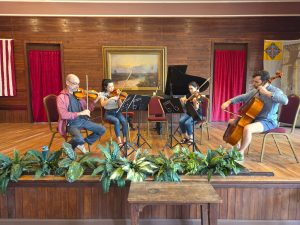
Camerata String Quartet, Boris Sandler, volin, Alice Hong, violin, Susannah Chalick, viola and Egor Antonenko, cello
A modest concrete marker along U.S. 41 near Corkscrew Road in Estero signals the entrance to Koreshan State Park, a historic site that can be easily overlooked by passing traffic. Beyond it lies one of Southwest Florida’s most distinctive cultural landmarks: Koreshan Art Hall, a 1905 structure that remains a living venue for intimate music events and community gatherings more than a century after it was built. Activities this season celebrate 120 years.
Classical pianist Bella Gutshtein and Artis-Naples violinist Boris Sandler opened this season’s first Koreshan Music Salon chamber concert to a full house at the 90-seat art hall, where the building’s original design affords remarkable acoustics without amplification. Their journey to presenting classical and chamber music in this intimate setting reflects a shared determination to bring close, immersive concert experiences to audiences in Estero.
The next concerts at the Koreshan Art Hall will be Sunday, March 22, and Saturday, May 23, at 3 p.m.
“We have the opportunity to perform extensive classical repertoires that can be presented by a few instruments played by musicians close to the audience,” Gutshtein said. “The experience is a shared event through the proximity of musicians and patrons.”
The March 22 concert features Beethoven’s Sonata for violin and piano, Schumann’s three romances and Ravel’s sonata for violin and piano with the 1885 Steinway Grand piano.
Russian immigrants in their youth, Gutshtein and Sandler came from different regions of the former Soviet Union and met through music in New York. A mutual friend brought Sandler to Gutshtein’s home, and they have been partners in music and life since. Both began formal music training as children and pursued advanced classical education at leading institutions.
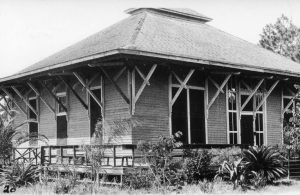
Exterior of the Koreshan Art Hall in 1910
Gutshtein frequently hosts gatherings in her Naples home, entertaining guests with food, music, poetry and literary discussion through what has become known as the Naples Salon.
“I was blessed to have my mother living with us,” she said. “We cooked for the salons and danced around the house with the enjoyment of music.”
After years of presenting poetry, music and educational events for adults and schoolchildren, Gutshtein and Sandler founded Camerata of Naples, a chamber orchestra that brings together local and nationally recognized musicians to present classical music to regional audiences. Finding the right venue led them to Koreshan State Park.
“When Ranger Michael Heare opened the door with a gold key, I was mesmerized by the beauty,” Gutschtein said. With restoration complete, the Art Hall fulfilled her vision of a historically grounded, intimate concert space.
Koreshan State Park preserves the remnants of a communal society, known as the Koreshan Unity, founded in the late 19th century by followers of spiritual leader Cyrus Teed. The group transformed swampland along the Estero River into a self-sustaining settlement which combined industry, education, publishing, horticulture and the arts within a religious belief system.
While the park is now appreciated for its historic buildings, walking trails, river views, kayak launch, camping facilities and natural beauty, its cultural significance remains central. The Koreshans envisioned a utopian society guided by equality, communal labor, education and the arts. At its peak, the community numbered about 200 residents, many from major cultural centers of the U.S.
“They were accustomed to music, literature and intellectual life,” said Ron Westcott, lead docent for the Estero Historical Society. “They didn’t leave culture behind when they came to Florida.”
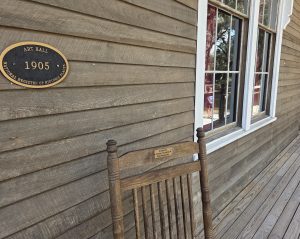
The Koreshan Art Hall was established in 1905
The Art Hall, completed in 1905, became the center for performances and community gatherings. Koreshan members lived communally, devoting time to education and the arts once daily work, including several businesses, was
complete. The Art Hall served as the center for music, lectures and social events, a role which continues today.
The building remains one of the park’s most intact structures. Seating about 90 people, it retains its original hardwood pine stage floor — resistant to termites — new hardwood flooring and restored red cedar walls. The red cedar boards were turned over to hide years of punctures from art displays, revealing well-preserved, clean surfaces. The hall’s acoustics remain exceptional.
“You don’t need amplification here,” Westcott said. “The sound carries naturally.”
“When I saw the stage, I knew it was perfect,” Gutshtein recalled.
“I knew it was right when I first put my bow on the violin,” confirmed Sandler.
Modern climate control protects the hall and ensures comfort for performers and audiences. Among its most prized instruments is an 1885 Steinway grand piano, with meticulously rebuilt interior mechanics maintained and restored by Steinway technicians.
Koreshans once welcomed visitors from Fort Myers, including those connected to the Edison and Ford estates, and presented choirs, orchestras, theatrical productions and lectures.
“This is a state park today, so what we do is guided by the overall system and available resources,” said Frank Rudy, a retired physician and tour coordinator for the Friends of Koreshan. “Within that framework, we’ve been able to offer concerts, movies and interpretive events that bring the history to life. The park is especially beautiful at night.”
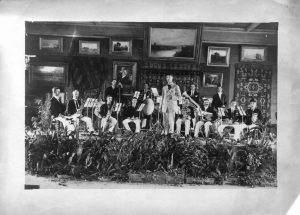
Koreshan Unity Orchestra, 1920
One of the park’s most popular programs, the Koreshan Ghost Walk, an evening historical tour featuring volunteers portraying actual Koreshan residents, is an annual event.
For many locals, Koreshan is a later-life discovery. Joe Archazki drove by the park for 50 years before stopping and later becoming a tour director.
“I enjoy the stories told by visitors finding artifacts throughout the park that often reflect their everyday life, from treadle sewing machines to scientific instruments associated with the Koreshans’ hollow-earth theory,” he said.
Gutshtein and Sandler are central to the revival of classical performances in the Koreshan Art Hall. Their chamber programs reflect both their heritage and the hall’s scale, emphasizing composers whose works were written for intimate venues. Local, regional and nationally known musicians participate in the series.
“The hall’s history adds an intangible dimension to each performance,” said Sandler.
“Chamber music belongs in a space like this,” confirmed Gutshtein.
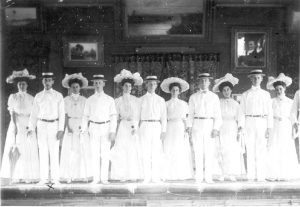
Theatrical performance in the Art Hall
Born in St. Petersburg, Russia, Gutshtein holds a master’s degree in music performance, vocal coaching and teaching. Since relocating to Naples in 2002, she has performed extensively with Artis—Naples and founded the former Estero Concert Series. Her programs often integrate music with history and literature and include educational components for young musicians.
Sandler, born in Tbilisi, Georgia, began violin studies at age 7 and later performed major concertos before immigrating to the United States in 1979. He studied at Juilliard and the Manhattan School of Music and has been a member of the Naples Philharmonic since 2001.
Founded by the couple, the Camerata of Naples ensemble draws on the region’s professional musicians and is inspired by the original 16th-century Italian Camerata. The 2026 season includes works by Poulenc, Prokofiev and Borodin, performed by Gutshtein, Sandler and other musicians affiliated with Camerata of Naples. Together, Gutshtein and Sandler continue to host the Naples Salon, sustaining their commitment to intimate, intellectually engaged musical experiences.
More than a century after its construction, Koreshan Art Hall remains what it was intended to be: a gathering place where culture, history and community intersect. Surrounded by preserved buildings, hiking trails and the Estero River, it offers visitors a rare opportunity to experience music in a setting where past and present meet with clarity.
Koreshan State Park and Camerata of Naples event info:
Koreshan State Park address: 3800 Corkscrew Road, Estero. Phone: (239)992-0311. Open 8 a.m. to sunset; $5 per vehicle daily entrance fee. For performance schedules and ticket information for all Koreshan Park events, visit friendsofkoreshan.org.
Camerata of Naples Inc. is a registered nonprofit organization. Tickets for the Koreshan Music Salon are $35. For performer and program information about all Camerata of Naples musical concerts, visit cameratanaples.org.
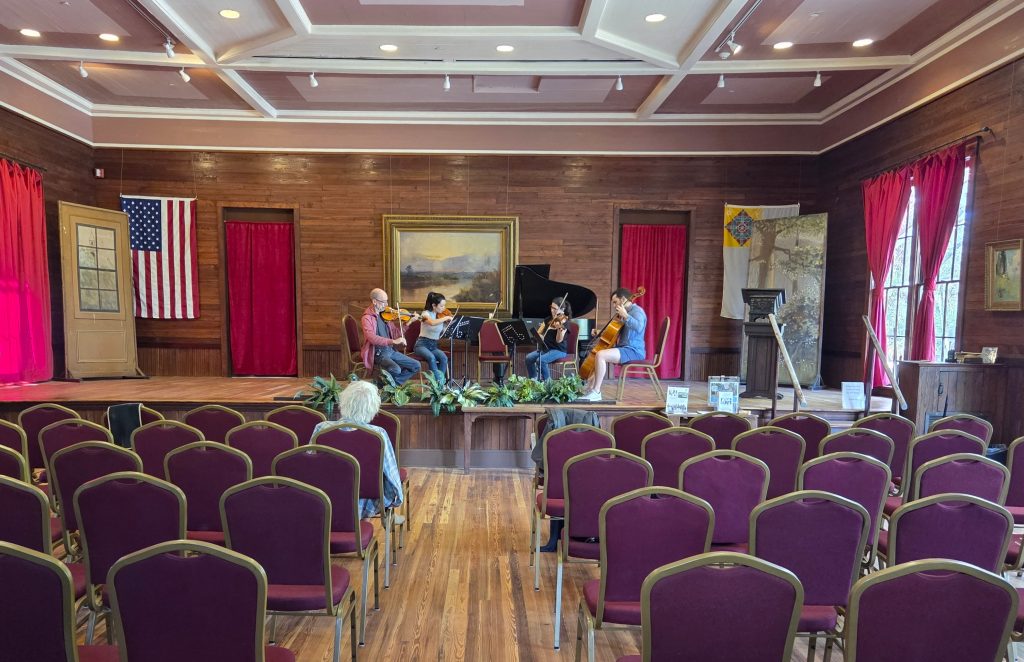
Bella Gutshtein oversees Camerata String Quartet rehearsals