Commercial and residential growth continues to shape Estero
By Cheryl Mandell
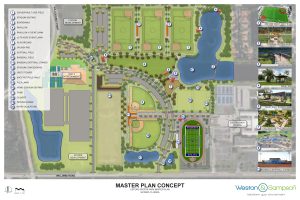
Estero Sports Park Master Plan
The secret is out – Estero is quickly earning a spot as one of the most desirable locations to call home in Southwest Florida. What once was considered just an exit off I-75 between Naples and Fort Myers is evolving into a destination in its own right – and that evolution contains many contributing factors.
Some call it tropical paradise, an escape from the frigid north, but for year-round residents of Estero, its desirability reaches far beyond the warm climate. Natural beauty, proximity to the Gulf, parks and recreation, landscaping and cleanliness, plus low municipal taxes and new infrastructure, are just some of the traits that make Estero a not-so-hidden gem.
As popularity grows, commercial and residential real estate follow suit. Construction is racing to keep up with demand for new housing, particularly in locations like eastern Corkscrew Road, where there is still ample land upon which to build.
Another response to increased demand is the $1 billion Terminal Expansion Phase 2 project at Southwest Florida International Airport. This project includes the expansion of the airport terminal on all three levels, including a new ticketing lobby and bag claim area, a new baggage handling system, a new Concourse E with 14 initial gates and the infrastructure to support 19 gates in the future.
In a recent presentation, Kevin Thorpe, chief economist and head of global research at Cushman and Wakefield, provided an economic summary of Southwest Florida and Lee County. From his perspective, Southwest Florida’s economy is thriving, outpacing the national and Florida state economies.
This positive trend is expected to continue, with housing prices projected to remain stable for the next four to five years, aided by new construction. The population will continue to grow for the foreseeable future; there is also a high demand for office space in Southwest Florida, as opposed to the national trend.
Chris Westley, Ph.D., dean of FGCU’s Lutgert College of Business, provides his local economic perspective for the coming year. “Our region’s economy is still one that tends to overheat during the boom and over-correct during the bust,” Westley said. “If the business cycle remains in an expansionary mode, I’d expect the regional economy to grow at faster rates than the national economy.”
Responsible Local Government
While geography plays an important role in its desirability, Estero’s conscientious governance and its economy have bolstered this slice of paradise to new levels.
The Village of Estero continues to maintain the lowest tax rate in the region and one of the lowest in the entire state. Last year, the Government Finance Officers Association presented the Village of Estero a budgeting award for its excellence in financial reporting.
The Village also received an AAA S&P Global Bond Rating, which is the highest rating when it comes to bond quality and demonstrates a strong capacity to meet financial commitments. Estero is one of only 12 other municipalities in Florida to earn this high of a rating, placing Estero in the top 3% in the state. The Village currently has no debt, but this rating would enable Estero to obtain the best interest rate if a future loan is needed to fulfill capital improvement projects.
This is an important tool in the Village’s toolbox, according to Village Manager Steve Sarkozy. However, he said, “Our policy is to pay for capital projects – pay as you go upfront – so we pay cash.”
Knowing when and how to purchase land or invest in other projects is something to which the Village is keenly attuned.
“In some cases, when buying property where the benefits of that acquisition are over time, every generation benefits from that acquisition property. We call that generational equity,” Sarkozy said. “Sometimes it’s best to pay for that over time rather than having this generation of Estero taxpayers pay the full shot upfront.”
The Utility Extension Project, or “septic-to-sewer,” has been designed, permitted and funded, and is now moving forward to eliminate pollution to the Estero River – a vital step to restore local waterways.
One of the innovative projects that has garnered much attention is the Estero Sports Park, a 100-acre property the Village secured along Via Coconut Point and Williams Road for future use as a multi-purpose recreational complex. This includes 21.2 acres previously owned by the Village, a lease on 52.8 acres of Lee County School District property, and purchase of 25.5 acres from Lee County for $700,000.
The final sports park plan by Village consultant Perez Planning includes three multi-purpose long fields, a baseball field, a softball field, new football stadium seating, a golf driving range, two lawns, a splash pad and a playground.
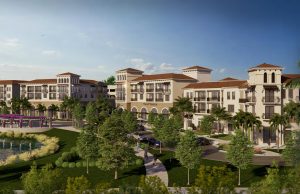
Rendering of Woodfield
The sports park is just the beginning. Looking ahead to 2025, improvements to Corkscrew Road, from Corkscrew Woodlands east, will add medians, sidewalks, lights and more. Planning and grant applications are underway for the Bonita Estero Rail Trail (BERT) on the Seminole Gulf Railroad, and Council approved a contract addendum for about $7.9 million with Manhattan Construction for construction of Estero on the River’s first phase. The Village also received a Florida Department of Environmental Protection (FDEP) grant of $750,000 for this project. Phase 1 improvements include an entry road, parking lot, restroom building, utilities, pedestrian bridge over the Estero River and walking paths.
The abundant commercial and mixed-use projects on the docket for 2025 and beyond, all in various stages of development, are a result of years-long efforts to support the growing needs of the community. From restaurants at Rapallo to the final phase of Genova at Corkscrew Road and Via Coconut, “Downtown Estero” at U.S. 41 and Broadway, and the Woodfield development at Coconut Road and Walden Center Drive, to name a few. The Woodfield project, which is “hot to go,” according to Village of Estero Development Director Mary Gibbs, includes 596 dwellings, 82,000 square feet of retail and dining use, a hotel with 260 rooms, 6,000 square feet of civic spaces, and 42,000 square feet of general and medical office use.
“I think it’s important to put things into perspective,” said Gibbs. “We don’t have a lot of vacant land left here, so what we do want is to have that high-quality development, trying to make a more balanced community so it’s not all just gated subdivisions. We really scrutinize it. We’re trying to be careful about how the development occurs.”
Careful scrutiny is essential in all aspects of growing a community.
“Underscoring all of this, we haven’t broken from our financial policies that got us here,” Sarkozy said, “doing things pay-as-you-go, maximizing grants, government lite, clean audits every year, lowest taxes in the region. The financial principles we have are our bedrock.”
Bidding Wars No More
According to FGCU’s Regional Economic Indicators December 2024 report, the Southwest Florida housing market is stabilizing, influenced by seasonal trends, recent hurricanes, and the overall normalization of the market following the heightened activity of 2021 and 2022.
The Lutgert College of Business Regional Economic Research Institute finds the housing supply in Southwest Florida, measured by residential active listings, has rebounded to pre-pandemic levels and suggests a more balanced real estate market.
Joe Pavich, Sr., of J. Pavich Realty World, shares similar perspectives. “Prices have held, inventory is going up a bit,” he said. “Now is a good time to buy, but there is a little bit more motivation on the seller’s side because of inventory. Days on the market have gone up. So that makes kind of a level playing field between the buyers and sellers.”
Pavich corroborates that the market has slowed down for two main reasons: interest rates and the cost of homeowners insurance are both high.
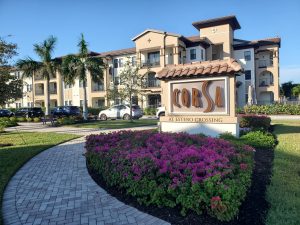
Corsa at Estero Crossing is a popular new rental community in Estero
Increasing insurance rates in the aftermath of Hurricane Ian has led to many insurers leaving the Florida market. Although more insurance companies will eventually enter the market, their positive impact will not be felt anytime soon. Annual premiums for insurance companies still offering coverage in Florida have increased by over 35%.
Pavich and his colleagues are seeing people who have been through multiple storms and sometimes remodeled more than once, now deciding they want to move east, away from flood zones to places like Verdana Village, Ave Maria and Babcock Ranch, which are all currently popular.
“Although the infrastructure isn’t there yet to the east, eventually that’s where the population is going,” Pavich said. “In the upcoming years, you’ll see it will get there.”
What are modern buyers looking for? Things like hurricane shutters and glass now increase the value of homes more than they used to. As insurance companies continue to be fastidious and policies are dropped after homes hit the 15-year mark with original roofs, new roofs have become an even hotter commodity than usual. Pavich finds that younger families are looking for new, move-in ready homes with automation and modern conveniences.
According to the local market update provided by Bonita Springs-Estero Realtors, the number of single family homes listed for sale increased 5.1% year-to-date, from 1,703 in 2023 to 1,790 this year.
The median sales price year-to-date for single family homes in the area for 2024 is $725,000, a mere 1.4% increase from 2023.
The BER report indicates that pending sales in both single family homes and condominiums are down. Pending sales for homes decreased by 7.2% for the year; for condos, that decrease was about 17%.
The sluggish condominium sales can be blamed, in part, on insurance issues that have affected association dues, repairs from storms, and assessments that have become extremely costly for some.
The rental market remains strong, from a realtor’s standpoint. Pavich notes that in the new Corsa development at Estero Crossing, only 10 units remain available for rent. A one-bedroom is renting for $2,200 minimum.
When asked what he believes to be some of the greatest local economic challenges, FGCU’s Westley has one issue top of mind.
“The biggest challenge, hands down, is workforce housing,” said Westley. “This situation was in a bad way even before the post-COVID inflation that makes housing unaffordable for entry-level and essential workers in our area. Employers tell me how much more difficult recruiting talent has become when prospective employees receiving job offers calculate their living expenses.”
Westley said there are no easy answers to this problem because it is caused by inflationary monetary policies beyond local control.
“Our county commissioners could mandate workforce housing tomorrow, but the solution is not that simple,” Westley said. “Capping rents for a special class of workers not only caps profits, it increases incentives to raise prices on other types of housing and to serve other segments of the housing market.”
With so many variables in the real estate market, Pavich is still looking forward to a good season. He’s optimistic that renters will turn into buyers. He also knows the value of the community in which he lives.
“With all of the new restaurants, entertainment and attractions heading our way, property values increase with an increase in amenities,” said Pavich. “A lot is happening in Estero – good things.”
Becoming the Destination
The Village of Estero continues to grow and change. Westley considers the pros and cons of such development.
“To answer questions like this, I always want to connect with my inner Don Eslick,” Westley said of the late community planning advocate known as “Mr. Estero.”
“What would Don say? The biggest pro is that the Village will have authority to manage this growth in ways that don’t exist in, say, Lehigh Acres or Immokalee. That is a note of optimism, notwithstanding the continued development along Corkscrew and the resulting increases in traffic and density.”
Westley favors market-based policies to manage the growth. If the population is increasing while resources are more-or-less constant, then rising prices would signal to many people to live somewhere else. But when municipalities lower these prices in the name of revenue zoning (zoning solely to maximize tax revenue), they hinder the market’s ability to manage growth.
“With respect to Estero,” Westley said, “I am not concerned about this outcome in 2025, as long as Village citizens continue to be engaged in growth management processes.”
Despite the explosive growth, the Village Council has worked hard over the past decade to establish standards to keep developers in check.
“In Estero, we have a very high benchmark for development that the council, over time, has established by adopting a comprehensive plan and then a land development code that guides where development can occur and what standards are to be applied,” said Sarkozy.
Estero residents are accustomed to traveling to Naples or Fort Myers for some types of recreation, but looking over the horizon, there will be many more options right in our own backyard. As the community evolves and invests in entertainment closer to home, Estero is truly becoming the destination.
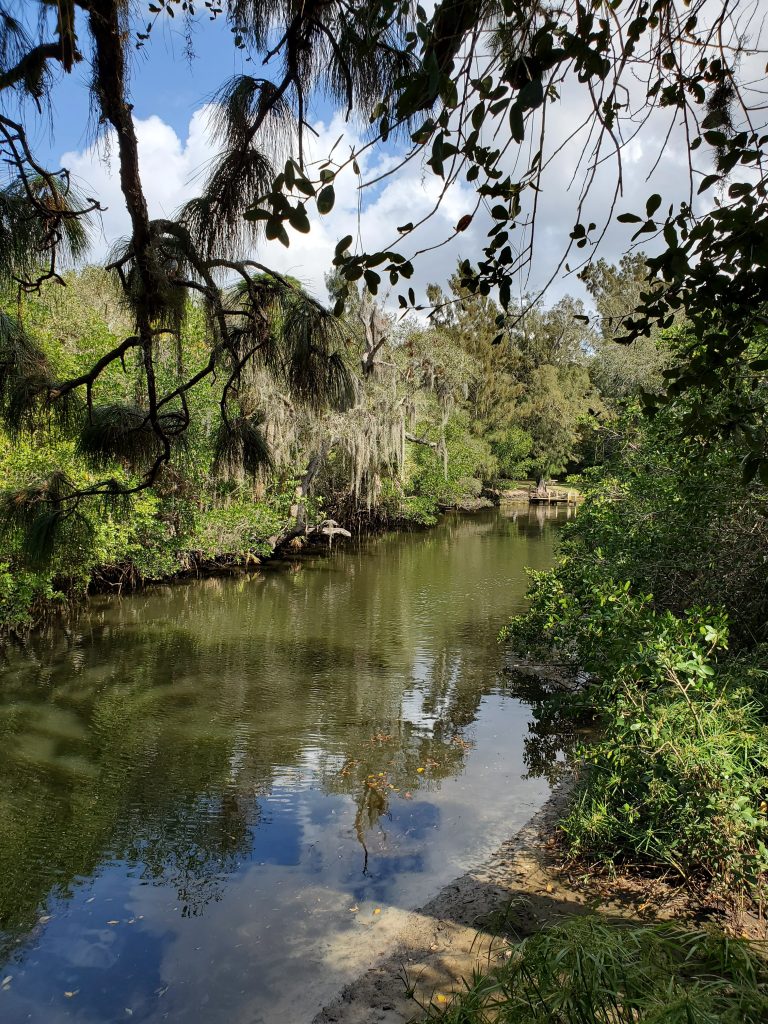
Council approved a contract addendum for construction of Phase 1 of Estero on the River project
