
Cutting-edge Cancer Care Comes to Estero
Southwest Florida Proton Center offers state-of-the-art cancer treatment
By Cheryl Mandell
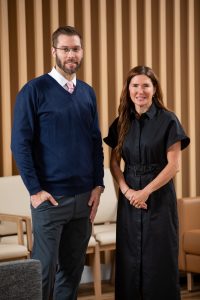
Dr. Todd Pezzi and Dr. Shannon MacDonald
There’s history in the making right here at the corner of Three Oaks and Estero Parkways. The most significant contribution to cancer care in decades is unfolding at the new Southwest Florida Proton Center.
The first proton treatment center on Florida’s Gulf Coast is a monumental medical development for numerous reasons. Most importantly, this center represents a lifesaving resource for cancer patients seeking revolutionary treatment options that are often elusive due to the proton technology’s complexities and hefty price tag for hospitals and private medical facilities. Southwest Florida Proton Center is one of only 46 proton therapy providers currently located throughout the U.S.
What is proton therapy? It is the most advanced radiotherapy treatment in existence, delivering highly concentrated radiation to the tumor via a proton beam. This technology pinpoints cancer tumors more precisely than ever, avoiding impact on healthy tissues around the treatment site. As a result, the treatment offers the lowest potential side effects, both long- and short-term.
According to the National Association for Proton Therapy, this unique therapy is an effective treatment option for a wide range of cancers, including cancers of the brain and spine, breast, esophagus, head and neck, liver, lung, eye, pancreas and prostate, as well as lymphomas and soft tissue sarcomas.
The good news doesn’t end there. Proton therapy is especially beneficial for treating pediatric patients because it is painless and extremely precise, minimizing damage to surrounding healthy tissue and allowing for more control of the radiation dose and accuracy — reducing the likelihood of complications and future health issues for children.
“This is super important for children because their tissues are more sensitive to radiation, and I believe 80% of kids are cured of their cancer (with proton therapy), so, the benefit for children comes from all those years that they live without developing a complication,” said Dr. Shannon MacDonald, senior medical director at Southwest Florida Proton Center.
The proton therapy machine, made by Ion Beam Application (IBA), is known as ProteusONE. This massively complex technology was delivered via a convoy of 10 semi trucks over 10 days to its new home in Southwest Florida, after enduring a cross-Atlantic journey that started at IBA’s manufacturing facility in Belgium. Assembly, testing and calibration have been underway for months and are expected to take a total of 9 to 12 months to complete. Once the ProteusONE is fully operational this fall, Southwest Florida Proton will become the first proton therapy center on Florida’s west coast.
While the proton therapy machine is still being prepared, the beautiful new facility is up and running with a comprehensive cancer treatment center. Located at 9961 Estero Oaks Drive, Southwest Florida Proton is housed within a 42,000-square-foot, three-story facility that also is home to Advocate Radiation Oncology, which provides traditional radiation outpatient therapy services, and Southwest Florida’s own Lee Health, which operates an outpatient diagnostic imaging center with Positron Emission Tomography (PET), Computed Tomography (CT) and Magnetic Resonance Imaging (MRI) capabilities.
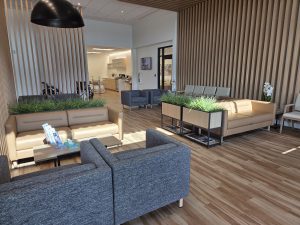
Modern decor provide a calming atmosphere at Southwest Florida Proton Center
After spending nearly 19 years of her career at Massachusetts General Hospital in Boston, the beauty of Southwest Florida and the region’s advances in medical technology are a win-win for MacDonald and her family.
“This is a great location for the facility because there is no other in Southwest Florida, and it will serve a large population,” she said. “It’s also very close to the Fort Myers airport, so I think patients may come from other places and choose this location if they don’t have a proton center nearby.”
When MacDonald began her career in Boston, there were three proton centers in the country, and her hospital participated with the engineers and physicists from MIT and Harvard to build the first one. The initial facilities had to be extremely large and needed a lot of shielding to start. There were huge construction costs, and depending on location, prices ranged anywhere from $150 million to $450 million.
Now, the units are smaller, and competitive engineering has driven down costs, but MacDonald is happy that IBA’s ProteusONE therapy machine is at Southwest Florida Proton Center. “The machine is state-of-the-art,” said MacDonald. She has worked with proton technology vendor IBA and is confident in their equipment and expertise.
All of the services, from proton therapy to diagnostic imaging and more traditional radiation therapy, are outpatient and performed in a relaxing, visually pleasing atmosphere, designed with intention to bring calm to patients during an emotionally and physically difficult time in their lives.
“I had an interest in physics as well as pediatrics, so the particle therapy was interesting to me from research — that was fascinating with the new technology. I saw how well the kids did when I was there, and how well other patients did with the difference in side effects that you could see just during the treatment,” said MacDonald.
The machine itself is quiet, and there is the ability to play music, listen to a podcast or audio book, or for children to watch videos, if they’re old enough to sit still. Sessions usually last about 20 minutes and are pain-free.
“Traditional radiation therapy is highly effective and the recommended course of action for many types of cancers, but proton therapy is quickly becoming a favored alternative because it offers extra protection for vital organs and nearby tissue while reducing side effects,” said Dr. Todd Pezzi, a radiation oncologist and medical director at Southwest Florida Proton.
“Proton therapy represents the future of radiation, and it’s exciting that we’ll soon be able to offer it here in Southwest Florida,” said Pezzi.
The children’s waiting room offers a clean, family-oriented space
