
‘Never Home’
Estero Photographer Releases Book Honoring America’s Fallen Heroes
By D. K. Christi
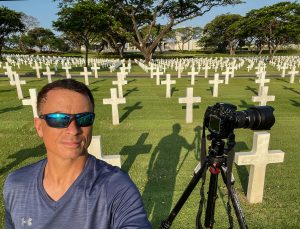
Photographer, author and veteran Richard Sherman at Manila American Cemetery, Philippines
In his recently released pictorial biography of American military cemeteries and the lives of those interred, Navy veteran and professional photographer Richard Sherman brings to life the poignant stories of 54 of the thousands of American soldiers who gave the ultimate sacrifice and never returned to U.S. soil. “Never Home: Remembering the Military Heroes Who Never Returned” highlights the significance of 23 American cemeteries on foreign shores through poignant photography and well-researched stories. This tabletop reference aims to keep fallen heroes’ legacies alive for future generations.
Through photos that capture the soul and a deep understanding of military history, Sherman, a resident of Estero, paints a vivid picture of military members’ brave contributions on the battlefield. He also sheds light on their personal stories and the emotional toll on families living far from their loved one’s final resting place.
“I hope that this presentation will encourage travelers to add these memorial cemeteries to their travel itineraries on foreign soil, many just a few steps away from popular tourist stops — a brief visit to pay homage and remember those who secured our freedoms and way of life today,” said Sherman, whose heritage includes a long line of family members in uniform.
“Too often, we forget about those who never returned home,” Sherman said. “Their graves may be across the ocean, but their stories and sacrifices belong to all of us. It’s crucial to keep their memories alive, to visit these hallowed grounds, and to remember that freedom is never free.”
They came from every walk of life, heritage, gender, and U.S. state and territory. Their histories from serving in World War I through the following wars are as diverse as our nation today.
These cemeteries, maintained impeccably by the American Battle Monuments Commission, house the remains of over 100,000 U.S. military personnel who died in foreign theaters beginning with World War I.
Among these cemeteries are:
· Normandy American Cemetery (France) – This cemetery overlooks Omaha Beach, where the D-Day landings took place. Over 9,000 U.S. soldiers rest here, including many who perished during the Normandy invasion.
· Meuse-Argonne American Cemetery (France) – The largest U.S. military cemetery in Europe, it contains over 14,000 graves of those who fought in World War I’s Meuse-Argonne Offensive.
· Henri-Chapelle American Cemetery (Belgium) – This cemetery holds over 7,000 U.S. soldiers, most of whom died during the Battle of the Bulge.
· Sicily-Rome American Cemetery (Italy) – Resting place for nearly 8,000 U.S. military personnel who died in the Italian campaign.
· Manila American Cemetery (Philippines) – The largest U.S. military cemetery outside of Europe, this site contains over 17,000 graves of service members who fought in the Pacific Theater during World War II.
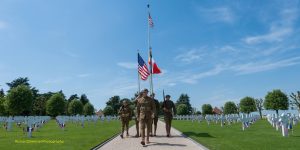
Honoring the fallen at Normandy American Cemetary in France
Other cemeteries explored in Sherman’s book include those in Luxembourg, Tunisia, The Netherlands, and even the distant islands of the Pacific. Each one represents not just a plot of land, but a profound symbol of the sacrifices made by Americans in global conflicts, underscoring the wide-reaching consequences of wars fought far from home. Sherman personally visited each cemetery during his multi-year journey.
Sherman’s quest to complete this work began with a simple comment from a Ukrainian taxi driver. The driver expressed special gratitude to his American comrades who served with him in Ukraine — far from their home — and even shared their rations from America.
Sherman’s inspiration grew as he traveled to each cemetery over a number of years. Art marketing consultant Mary Virginia Swanson helped Sherman with the details of publishing such a record. It’s “not a full history but a pictorial and human story record, a testament to the importance of remembrance,” Sherman said.
The book’s organization into three sections provides the reader with an in-depth appreciation of the beauty and care taken to honor the fallen. Sherman captured cemeteries from multiple vantage points, at different times of day, in varying weather, close up and from a distance.
Window into Grief and Patriotism
Sherman’s personal military experience influenced his careful research, leading to poignant stories that represent the sacrifice of military families. They include ordinary to extraordinary people who were just neighbors and colleagues before the war.
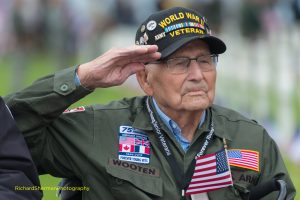
WWII Veteran salutes at the 75th Anniversary of the Normandy invasion, 2019
Three brothers in the U.S. Army who lost their lives abroad are buried together in Henri-Chapelle American Cemetery. The oldest, Robert Tester, was killed off the coast of Tunisia when his transport ship sank. Before the war, he was a farmer and woodworker. James Tester survived D-Day on Utah Beach but died in combat at the Siegfried Line in Germany. Before the war, he worked for the Civilian Conservation Corps. The youngest, Glenn Tester, received the Purple Heart and was killed in the Vosges Mountains of France. He was 27, having left a wife and their 3-month-old son when he was deployed to Italy.
At the Manilla American Cemetery, five brothers are honored: George, Joseph, Albert, Madison and Frances Sullivan. They enlisted in the U.S. Navy under the condition they would serve together. The five brothers all perished in the Battle of the Guadalcanal when their ship was hit by a torpedo and sank in four seconds. Their parents continued to sell war bonds, and two ships were subsequently named to honor their sons.
The famous George S. Patton is interred at the Luxembourg American Cemetery. He died in a car accident in Germany shortly after the end of the war and, against his family wishes, he insisted on being buried with his men.
Through interviews with surviving family members, veterans and caretakers, Sherman highlights the gravity of these distant resting places. These cemeteries have become international symbols of friendship and shared sacrifice, he said.
In the current time of international conflicts, Sherman’s “Never Home: Remembering the Military Heroes Who Never Returned” is a call to remember extraordinary heroism and the painful costs of war. His book urges readers to think not only of the soldiers who returned as heroes but also of those who remain in foreign fields — enduring ties between the United States and the countries where these cemeteries stand.
See more of Sherman’s work online at neverhomeheroes.com and richardshermanphotography.com
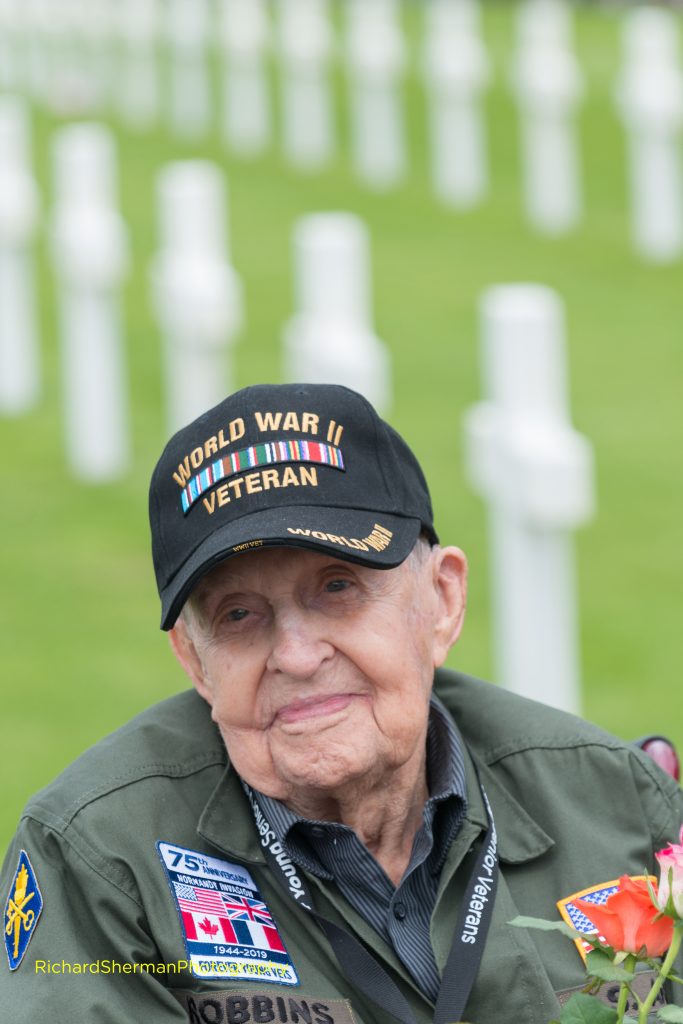
WWII Veteran at the 75th Anniversary of the Normandy invasion, 2019