
The Wall: A Hero’s Message of Healing
Local Vietnam War Veteran Offers Closure with Poignant Poem
By Cheryl Mandell / Photos by Cheryl Mandell and courtesy of Robert Chapin
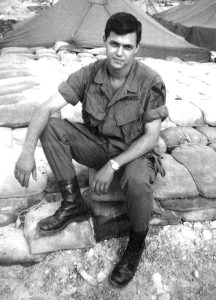
Sergeant Robert Chapin during his tour in Vietnam, February 1968.
The Vietnam War Memorial is many things to many people. It is the most-visited memorial on the National Mall in Washington D.C., attracting more than 5 million visitors each year. The most prominent feature of the memorial is a massive wall that lists the names of over 59,000 service members who lost their lives during the Vietnam War. Parents, widows, children and veterans are drawn to this memorial in search of loved ones, comrades and friends.
For Estero resident and decorated Vietnam veteran Robert Chapin, that granite wall is a place where grief and inspiration struck together like a bolt of lightning, and resulted in a poem that changed his life and the lives of many veterans over the past four decades.
The Catalyst
The Vietnam War Memorial was the catalyst for Chapin’s poem entitled, “The Wall,” but the raw emotions behind the poem stemmed from the real-life experiences of the author.
Prior to his assignment in Vietnam, Chapin joined the U.S. Army’s four-year program with the promise of a non-combat assignment in Europe. He served 16 months in Frankfurt, Germany with the prestigious 513th Military Intelligence Brigade as a top secret cryptographer, posing as a civilian while interpreting messages sent in code. In early 1968, Chapin was sent to Vietnam to serve with the 1st Cavalry Division (Airmobile), 13th Signal Battalion.
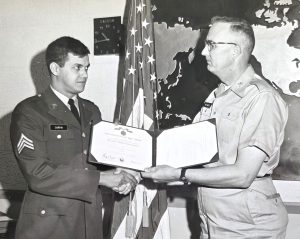
Sergeant Chapin is presented with the award for heroism by Colonel Rames at the Pentagon, 1969.
His skills as a decoder were never utilized. Instead, Chapin was tasked with securing elusive items by any means necessary. He also delivered food to field combat units and removed bodies of fallen soldiers for transport back to the U.S. for burial.
On Feb. 23, 1968, during an enemy attack at Phuoc Vinh in Vietnam, the unit’s base camp came under intense enemy rocket and mortar attack. Sergeant Chapin faced the hostile barrage to administer first aid to wounded comrades, which later earned him several Army commendations, including the Bronze Star Medal for heroism and Silver Star for gallantry.
Several months later, in July 1968, Chapin was seriously wounded when his helicopter crashed during a North Vietnamese attack. He was ultimately awarded the Purple Heart for the wounds he received during this enemy assault. The Purple Heart is the oldest military award still given to members of the U.S. Military, originally established by President George Washington as the Badge of Military Merit.
The Memorial
The Vietnam Veterans Memorial Fund, Inc. is the nonprofit organization authorized by Congress in 1980 to fund and build the Vietnam Veterans Memorial. The organization sought a tangible symbol of recognition from the American people for those who served in the war.
The faces of visitors are reflected in the wall, which is composed of polished black granite, to connect visitors with those who died or are missing in action.
The memorial was dedicated on Nov. 13, 1982. American architect Maya Lin designed the Vietnam Memorial as an undergraduate at Yale. The concept was for the memorial to be a quiet protected place that complements the layout of Constitution Gardens. Lin’s intention was to have the names appear chronologically, to tell the timeline of the war.
This design allows veterans, friends and family members to find loved ones by their date of casualty. It also enables veterans to find groups of friends who died during the same incident, with fallen comrades together on the wall.
The Poem
In 1983, Chapin visited the Vietnam Veterans Memorial, searching for the name of a friend killed during an attack by the North Vietnamese. When he returned home to develop the photos he took of the names on the memorial, he noticed the name of his high school best friend, Arvid O. Silverburg. Chapin called Silverburg’s mother and learned that his old friend was a Medivac helicopter pilot who had been shot down and killed while trying to save people — a direct violation of the Geneva Convention.
“The Vietcong shot upon the helicopter and killed all seven people,” said Chapin. “And that’s what really stuck with me.”
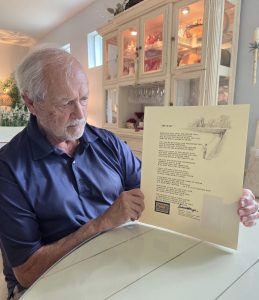
Chapin reflects on his famous poem, The Wall
This grim news affected Chapin so much that he returned to Washington to visit Silverburg’s name on the memorial. The overwhelming grief and bitterness prompted Chapin to pen “The Wall,” a heartfelt poem written in a mere 15 minutes.
After self-publishing the poem, he sent “The Wall” to his Congress representative, Silvio Conte in Massachusetts, who forwarded it to President Ronald Reagan. Along with a letter from the president in 1984, “The Wall” was displayed in the Oval Office, the first Vietnam poster of its kind and the number one selling poster print of Vietnam ever, which it remains to this day.
In 1985, the poster was awarded the top ABC News award in the country following Chapin’s reading of the poem on the evening news broadcast to hundreds of thousands of viewers.
The award-winning poem has also been presented to Neal Armstrong, Buzz Aldrin, Presidents Bill Clinton, George H.W. Bush, George W. Bush and Barack Obama. Many senators and members of Congress also display this poster in their offices. The poem, which has sold in excess of 250,000 copies, also resides in the Ronald Reagan Presidential Library in Simi Valley, California.
One of Chapin’s favorite stanzas from the poem is, “You can see his young and frightened face, see the awesome firepower. How do you tell the Gold Star mother, she has lost her blooming flower?”
“The Wall” isn’t just composed of words. Each printed poster contains the poem complemented by a hauntingly beautiful pencil drawing of Chapin himself staring into the Vietnam Veterans Memorial wall, searching for his fallen comrade. The illustration was created specifically for Chapin by his friend, illustrator Ernest A. Goudreau.
“All I can say is, this thing hit me more than anything has ever hit me in my life,” said Chapin. “The fact that I found a name on the wall, made it more than a wall, it was a feeling.”
Today, Chapin dedicates his time to helping fellow veterans and their families achieve a sense of closure about the Vietnam War. He signs special copies of his poem at the request of people around the nation.
“The Vietnam War was one of the worst things that ever happened in this country,” Chapin said.
The Author
The whirlwind success of “The Wall” and the lives he touched over the years inspired Chapin to write other poems and short stories, many of them about the war. He has also written two full-length novels. His first story, published in digital format in 2010, called “Orphans of the Mourning,” is about a soldier in Vietnam who eventually becomes the first Vietnam veteran president of
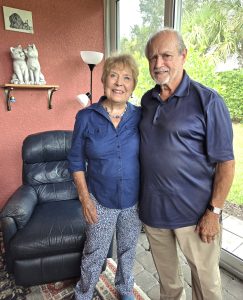
Maureen and Bob Chapin in their sunroom in Tidewater
the United States. His second novel, “Murder in Ogunquit,” is a mystery that takes place in the small New England coastal town of Ogunquit, Maine.
After a successful career as chief lead in maintenance with U.S. Airways in Springfield, Massachusetts, Chapin retired and set his sights south, first to Virginia, and then Florida came calling.
“After retiring, Maureen and I decided that we wanted to move down to Florida,” said Chapin. “Maureen had a very successful business for many years, and she was at the point where she wanted to leave the north. We were done with standing in the snow.”
The Chapins currently split their time between their homes in Fredericksburg, Virginia and Estero. They resided seasonally in Bonita Bay for nearly 20 years before relocating to the Tidewater community in Estero nine years ago.
The Impact
Nearly 45 years after writing “The Wall,” Chapin continues to reach veterans and their families here in Southwest Florida.
In a generous effort to support local veterans and contribute to the Bonita Springs Concert Band, Chapin has produced 500 signed copies of the poem, available to those who attend the November Veteran’s Day concert on Saturday, Nov. 2, at 6 p.m at Riverside Park in Bonita Springs. The poet himself will be set up at the concert for a meet and greet, and to accept donations for the poems, which will benefit the Bonita Springs Concert Band.
Each poster also includes a rare U.S. postage stamp and the impression of Chapin’s Purple Heart. The Purple Heart is in memory of the 59,687 military members who have received the award posthumously for their sacrifice.
“I hope that for those Vietnam veterans who are still struggling, if they have the opportunity to look at my poem or receive one of these, it really is healing for a lot of people,” said Chapin. “The fact is, I was moved by The Wall, and you will also be moved by The Wall, regardless of how you feel.”
To learn more about “The Wall” or to inquire about obtaining a copy, please email Bob Chapin at Flyboy1219@gmail.com.
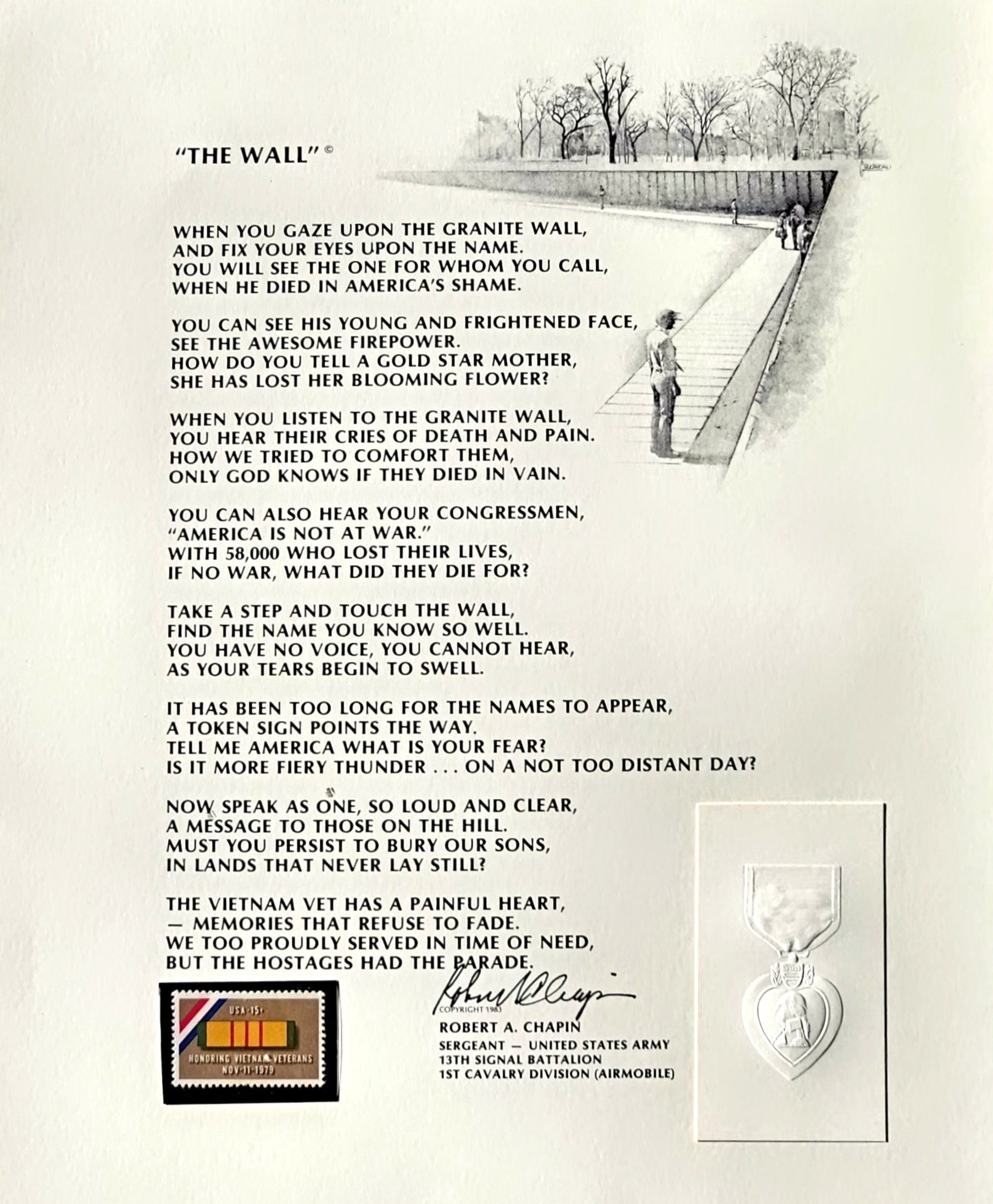
Robert Chapin’s poem with illustration_ signature and purple heart embossment