
Building the Future of Healthcare
FGCU’s Marieb College Expands Academic and Workforce Opportunities
By Cheryl Mandell | Photos courtesy FGCU/James Greco
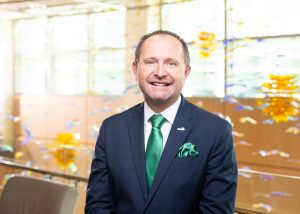
Shawn Felton, dean of Marieb College of Health and Human Services
Florida Gulf Coast University is responding to the healthcare workforce deficit in a significant way with the construction of Marieb Hall South, a transformative, $117.1 million expansion of the Marieb College of Health and Human Services that promises to reshape healthcare education throughout the region.
Scheduled to welcome students in spring 2029, the four-story, 158,040-square-foot facility will become the largest academic building on the FGCU campus. Marieb Hall South was designed by RG Architects and HuntonBrady Architects. The state approved and funded $117 million for the first phase, and $27 million for the second phase is currently in the legislative process. FGCU held a groundbreaking ceremony on April 15.
Marieb Hall South represents a bold investment in the future of Southwest Florida’s healthcare workforce, combining advanced technology, interdisciplinary education and community partnerships under one roof.
“What we’re trying to do is future-proof our workforce for healthcare,” said Shawn Felton, dean of FGCU’s Marieb College of Health and Human Services.
That vision extends far beyond traditional healthcare education.
The Marieb College has earned a reputation for preparing professionals who work collaboratively across healthcare disciplines, reflecting the increasingly team-based nature of modern medicine.
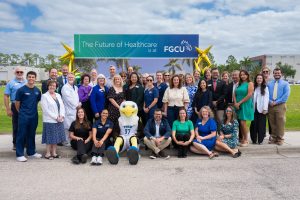
FGCU Marieb Hall South groundbreaking, April 15, 2026
The college encompasses a diverse collection of academic programs, including the School of Nursing, School of Allied Health, Department of Social Work, Department of Counseling, Healthcare Administration, Public Health, Health Sciences, Occupational Therapy, Physical Therapy, and Physician Assistant Studies. Together, these programs create an educational environment that mirrors today’s clinical settings, preparing graduates for careers that touch nearly every aspect of patient care and community wellness.
“FGCU is a cross-discipline institute, building programs based on community needs. There is a fascinating connectedness,” Felton said.
Marieb Hall South has been intentionally designed to support that collaborative philosophy.
The first floor will house Counseling and Psychological Services, Student Health Services, the Golisano Intellectual and Developmental Disability Initiative, social work and counseling programs, along with research facilities.
The second floor will feature a remarkable 32,000-square-foot interprofessional simulation center, allowing students to train together using realistic patient scenarios before entering clinical environments. Specialized laboratories and classrooms for nursing and physician assistant education will occupy the third floor, while the fourth floor will largely serve as an organizational hub for the Shady Rest Institute on Positive Aging.
The Shady Rest Institute reflects another pressing reality facing Southwest Florida. With one of the nation’s fastest-growing senior populations, the region needs innovative research and education focused on healthy aging. The institute will bring together faculty, students, healthcare providers and community organizations to explore ways to improve quality of life for older adults while advancing research on aging, caregiving and wellness.
“We have a diverse set of core and affiliate faculty members from a variety of academic disciplines,” said Thomas Felke, executive director of Shady Rest Institute on Positive Aging. “The area set aside for the institute will provide an opportunity for these individuals to collaborate more efficiently.”
Technology will play a central role throughout the new building.
Students will train in sophisticated simulation environments that include intensive care units, operating rooms, labor and delivery suites, and immersive virtual learning spaces. High-resolution projection technology, advanced patient simulators and specialized laboratories will create lifelike clinical experiences to strengthen decision-making before students ever treat actual patients.
“The simulation areas will provide opportunities for the faculty and their students to conduct applied research on issues affecting older adults, evaluate community programs, secure external funding, prepare the next generation of professionals supporting older adults, and translate research findings into practical solutions for both policymakers and service providers,” Felke said.
Research spaces, a medical maker space and multimedia production studios will further expand opportunities for innovation and interdisciplinary collaboration throughout the facility. Much of this technology is being supported through a $22 million gift from the Elaine Nicpon Marieb Charitable Foundation, the largest cash donation in FGCU’s history.
For Brenda Hage, director of the School of Nursing, those investments directly translate into better prepared graduates.
“The new building will have expanded classroom, laboratory and simulation facilities that will be state-of-the-art,” Hage said. “Nursing is an applied discipline. The new technologies that will be available to our students will provide rich opportunities for them to develop the critical thinking and clinical judgement needed to be safe and effective nurses and advanced practice clinicians.”
Those graduates will enter a healthcare workforce facing unprecedented demand. Florida continues to experience population growth, particularly among older adults, increasing the need for nurses, therapists, physician assistants, counselors and other healthcare professionals. National projections mirror local concerns, making workforce development one of the state’s highest priorities.
Hage points to one particularly sobering statistic. “Florida is expected to experience a shortage of approximately 60,000 nurses by 2035,” she said. “My biggest hope is that we can continue to grow our faculty and clinical placements to prepare more nurses to serve the healthcare needs of our communities. We need more nurse educators to help achieve this goal, which is why we have an MSN program in nursing education.”
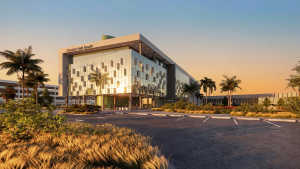
Rendering of the new Marieb Hall South
FGCU has spent years building partnerships that allow students to gain real-world experience while helping meet regional workforce demands. Local affiliations provide students with opportunities for hands-on learning, with major Southwest Florida partners such as Lee Health and medical device leader Arthrex helping bridge the gap between classroom education and professional practice. These collaborations expose students to cutting-edge technologies, clinical environments and research opportunities while creating a direct pipeline of highly qualified graduates into the regional workforce.
Felton believes those relationships are among the college’s biggest strengths.
“We have had great support from clinical partners, with over 1,500 affiliations,” he said. “Our investing partners receive the dividend of a skilled workforce back into the community.”
That community-centered philosophy has become a hallmark of FGCU since the university opened 29 years ago. As Southwest Florida has evolved, the university has continually adapted its academic offerings to meet emerging workforce needs, and commitment is abundantly clear within Marieb College.
FGCU President Aysegul Timur said the university’s healthcare expansion represents a transformative investment in the future of Southwest Florida and reflects FGCU’s commitment to anticipating and addressing the region’s evolving skilled workforce needs.
“Through strategic investments in healthcare education, FGCU is strengthening the talent pipeline, advancing the health of our communities and building a more resilient Southwest Florida for generations to come,” Timur said.
The new Marieb Hall South represents more than bricks, mortar and advanced technology. It is an investment in stronger regional healthcare systems and future generations of professionals who will care for the families in Estero and beyond.
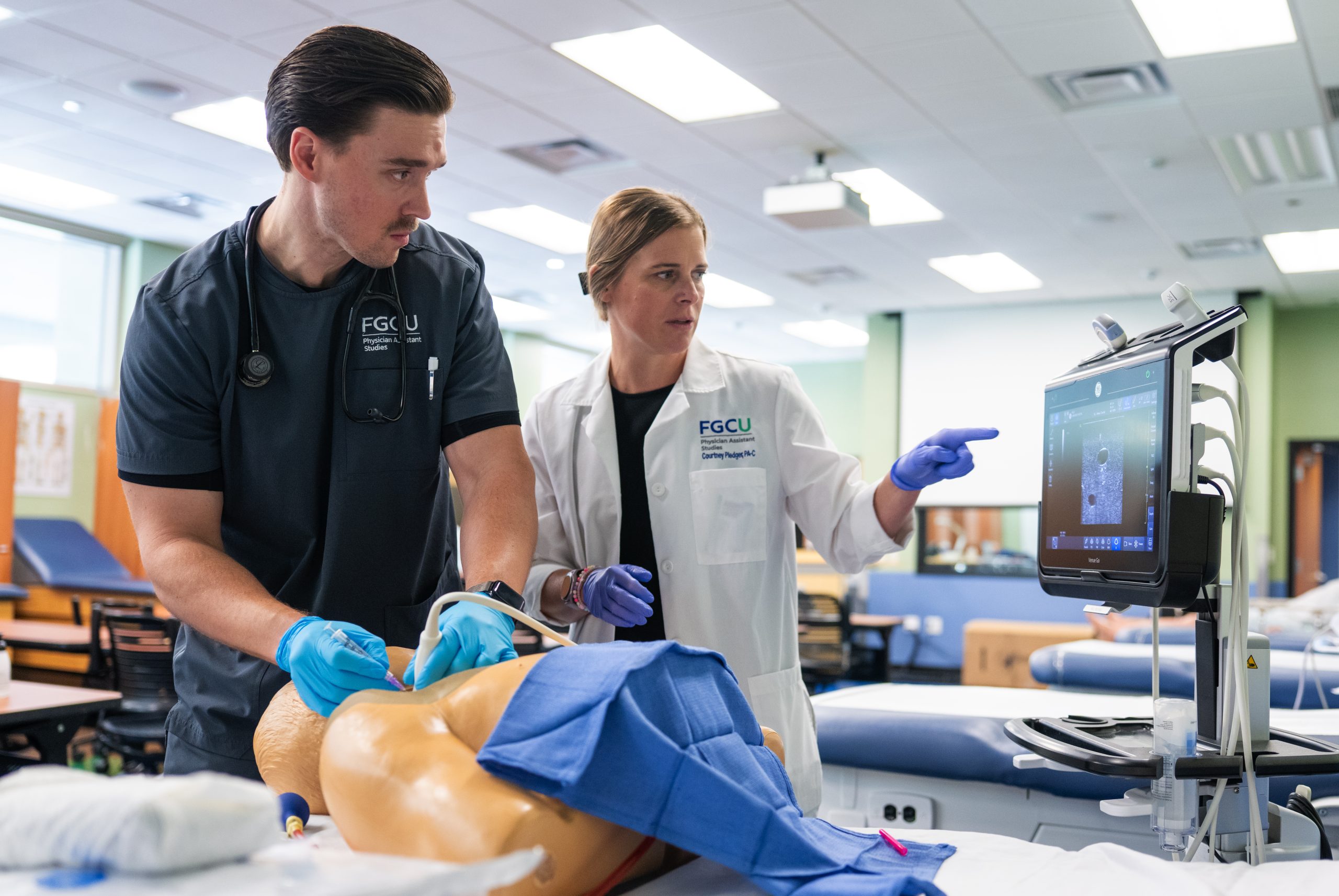
The extraordinary donation from Marieb Foundation enables greater hands-on learning